The 3 Types of Bookkeeping (And Which One You Need)
Bookkeeping is one of the most important parts of running a successful business. Proper bookkeeping helps business owners track income, manage expenses, understand financial performance, and stay compliant with tax laws.
For small business owners, having organized financial records can make the difference between making confident decisions and operating in the dark.
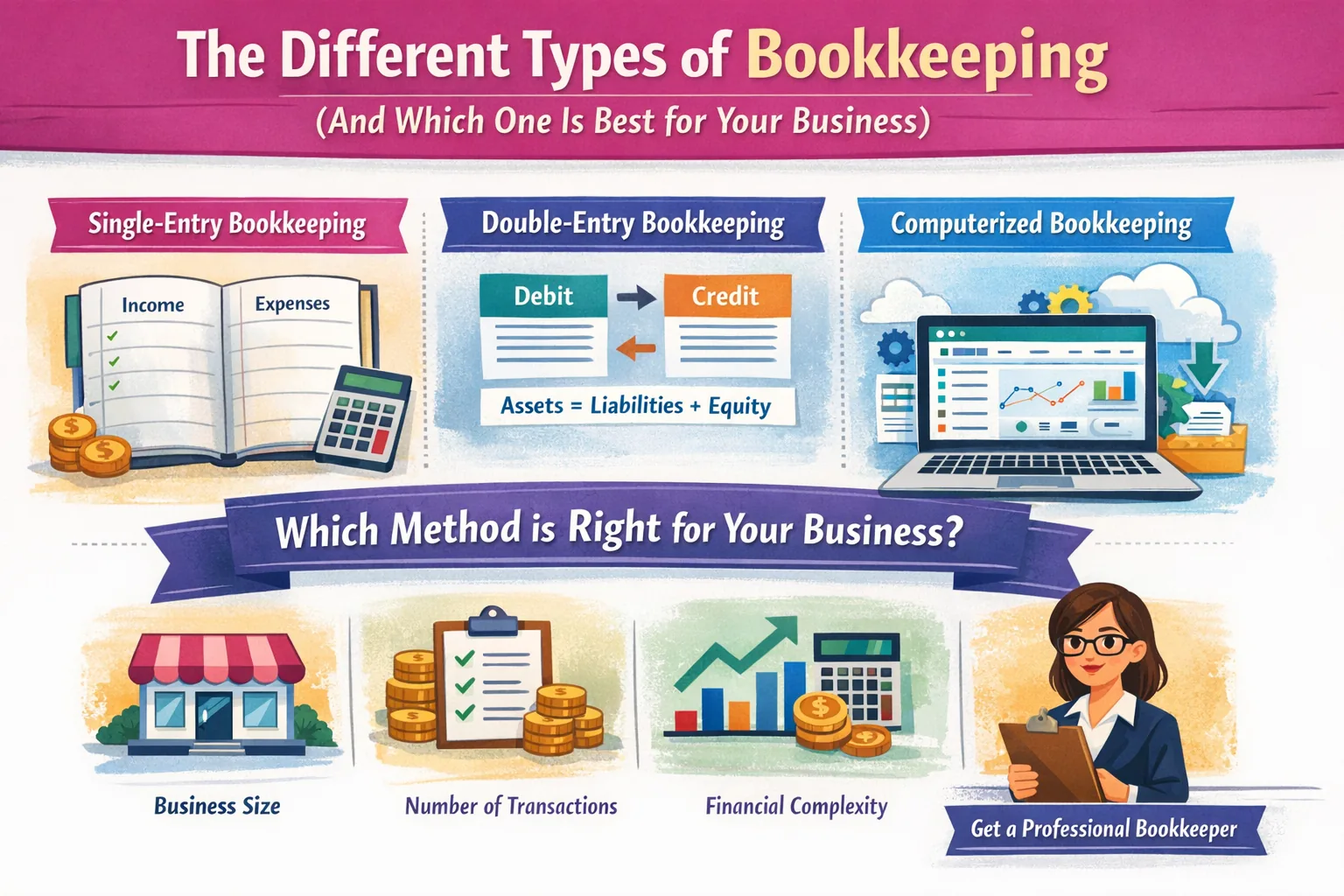
There are several types of bookkeeping systems available, but most businesses use one of three primary methods:
- Single-entry bookkeeping
- Double-entry bookkeeping
- Computerized bookkeeping
Understanding these methods can help you determine which system is best for your business.
Single-Entry Bookkeeping
Single-entry bookkeeping is the simplest form of bookkeeping. In this system, each financial transaction is recorded only once, typically as either income or an expense.
This method is commonly used by:
- Sole proprietors
- Freelancers
- Very small businesses with few transactions
Because it is simple, single-entry bookkeeping does not require extensive accounting knowledge or specialized software.
However, this method also has limitations. It does not provide a complete picture of a company’s financial health because it does not track assets, liabilities, or equity in detail. As a result, it may be difficult to produce detailed financial reports.
For businesses that are growing or handling more transactions, a more advanced bookkeeping method is usually recommended.
Double-Entry Bookkeeping
Double-entry bookkeeping is the most widely used accounting system for businesses today. In this system, every financial transaction is recorded in at least two accounts: one debit and one credit.
This method is based on the fundamental accounting equation:
Assets = Liabilities + Equity
Because every transaction affects two accounts, double-entry bookkeeping provides a more accurate and complete picture of a business’s financial position.
Benefits of double-entry bookkeeping include:
- More accurate financial records
- Easier error detection
- Detailed financial reports
- Better financial decision-making
Most businesses that want reliable financial reporting use the double-entry system.
Computerized Bookkeeping
Computerized bookkeeping uses accounting software to manage financial records. Instead of manually recording transactions in ledgers, businesses can use software that automates much of the bookkeeping process.
Popular accounting software like QuickBooks Online allows businesses to:
- Import bank transactions automatically
- Track expenses and income
- Send invoices to customers
- Reconcile bank accounts
- Generate financial reports
Computerized bookkeeping reduces manual work, minimizes errors, and provides real-time financial information.
Today, most small businesses rely on computerized bookkeeping systems because they are faster, more accurate, and easier to manage.
What About Manual Bookkeeping? The Fourth Type
You will sometimes see bookkeeping described as four types instead of three, with manual bookkeeping counted as the fourth. Manual bookkeeping means recording transactions by hand, either in a paper ledger or a spreadsheet. The distinction is worth understanding: single-entry and double-entry describe the system you use, while manual and computerized describe how you record it. You can keep a double-entry set of books by hand, and you can keep single-entry books inside software. Manual bookkeeping still works for a very small operation with only a handful of transactions a month, but it takes far longer and it is much easier to make a mistake that goes unnoticed for months.
Choosing the Right Bookkeeping System for Your Business
Selecting the right bookkeeping method depends on several factors, including:
- The size of your business
- The number of financial transactions you process
- The complexity of your finances
- Your familiarity with accounting systems
Small businesses with limited transactions may find single-entry bookkeeping sufficient. However, as businesses grow, many owners transition to double-entry or computerized bookkeeping to gain better financial insights.
Working with a professional bookkeeper can help ensure that your financial records are accurate, organized, and compliant with tax regulations.
Need Help With Your Business Bookkeeping?
Keeping your books organized can be challenging while also managing your business's day-to-day operations. A professional bookkeeper can help ensure your financial records stay accurate and up to date.
At BDE Bookkeeping Solutions, we help small business owners maintain clean books, understand their financial reports, and make informed business decisions.
If you are looking for reliable bookkeeping services in Tennessee, we are here to help.
Final Thoughts
Bookkeeping is the foundation of strong financial management. Choosing the right bookkeeping method can improve financial clarity, support business growth, and help ensure compliance with tax laws.
Whether you are just starting a business or managing an established company, having an effective bookkeeping system is essential for long-term success.
Frequently Asked Questions
What is the difference between single-entry and double-entry bookkeeping?
Single-entry records each transaction once, like a checkbook register. Double-entry records every transaction twice, as a debit and a matching credit, so the books must balance. Double-entry is what produces a balance sheet and what catches errors that single-entry hides.
Which type of bookkeeping do most small businesses need?
Double-entry, kept in accounting software. It is what lenders, investors and tax preparers expect, and it is what produces a balance sheet. Single-entry is only workable for the very smallest operations with no inventory and no liabilities to track.
Do I need double-entry bookkeeping if I am a sole proprietor?
Not always, but it helps sooner than most owners expect. If you carry a loan, hold inventory, or ever want to know what your business is worth rather than just what it earned, you need a balance sheet, and that requires double-entry.
Is computerized bookkeeping the same as double-entry?
Usually but not automatically. Most accounting software is double-entry underneath. Some of the simplest tools aimed at freelancers are not, and they cannot produce a balance sheet, which is the point worth checking before choosing one.
Can I switch bookkeeping methods later?
Yes, though it means establishing opening balances as of the switch date and, ideally, rebuilding at least the current year so one tax year sits in one system. It is easier to start with the method you will still want in two years.
If computerized bookkeeping is the right fit, the setup is what decides whether it actually works. Read next: How to Set Up QuickBooks Online for a Small Business.